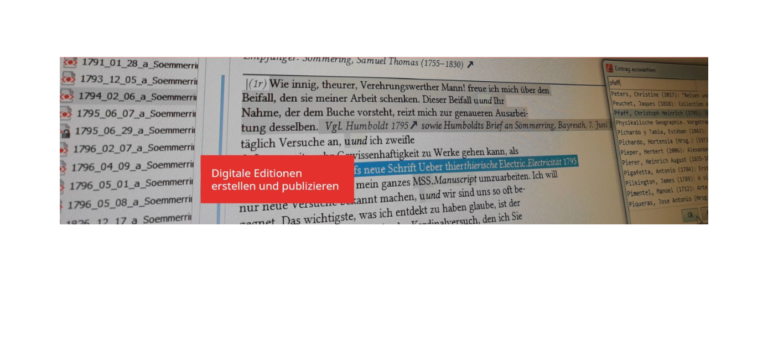
Die Website schafft einen schnellen und unkomplizierten Zugang zu den Werkmaterialien des österreichischen Literaturnobelpreisträgers Peter Handke.
Short description of the project
The Diccionario del Español Medieval electrónico (DEMel) is a semantically pre-structured and lemmatized database dedicated to the Medieval Spanish. The basis is the digitized archive of the Diccionario del Español Medieval (DEM), which was discontinued at the end of 2007 for financial reasons. With more than 600 literary and non-literary works or collections of texts and documents as sources, the material represents the Spanish vocabulary from the 10th to the beginning of the 15th century.
Project content
The project Diccionario del Español Medieval electrónico (DEMel), funded by the German Research Foundation, aims to create a lemmatized and semantically pre-structured electronic data archive on medieval Spanish that is freely available and searchable on the Internet. Based on the digitized archive of the renowned Diccionario del Español Medieval (DEM), it provides access to over 31,000 lemmas with about 650,000 attestations from the 10th to the beginning of the 15th century.
In the course of digitization and indexing, approximately 865,000 paper slips - including around 700,000 slips on which the medieval word forms are written with their respective context of use, the source and their dating as well as, for example, grammatical, semantic and etymological information - were first scanned. Afterward, the project team developed a database structure and recorded the information contained on the paper slips manually.
The DEMel web portal developed at the University of Rostock now offers users the opportunity to evaluate the material in a structured manner according to their individual research questions using several search and filter functions. The great diversity of topics and text types covered by the underlying corpus (fiction, religious and legal documents, technical and scientific treatises on astronomy, mineralogy, botany, etc.) makes it possible to examine previously unrecorded aspects of medieval Spanish vocabulary. This makes the web portal a valuable source of information for Hispanists as well as for scholars from other disciplines (e.g. Arabic and Jewish studies, theology and Latin studies).
dem.electronico@uni-rostock.de
Find out more at
https://demel.uni-rostock.de/
Add your DH research project to the project showcase by submitting a short project description via the web form. Enter project data, a brief description, a graphic or visualization as well as a detailed description of the project content with technical assignment, addressees, added value, project managers, funding information and duration.

Die Website schafft einen schnellen und unkomplizierten Zugang zu den Werkmaterialien des österreichischen Literaturnobelpreisträgers Peter Handke.

In Kooperation zwischen der Universität Hamburg und der Staats- und Universitätsbibliothek Hamburg werden die ca. 35.000 handschriftlichen Originalbriefe des Dehmel-Archivs

Das Hamburger Zentrum für Sprachkorpora berät und unterstützt bei der Erstellung und Nutzung digitaler Sprachkorpora in Forschung und Lehre: Es

Das Zusammenwirken von über 1,200 Projektbeteiligten aus über 50 Ländern ermöglicht eine umfassende Darstellung der „Urkatastrophe des 20. Jahrhunderts“ in
Nachhaltiges Forschungsdatenmanagement ist zentral für künftige Forschungen! Dies zeigt etwa die Geschichte der Bonner Längsschnittstudie des Alterns. Fast zwanzig Jahre

Die Website „Der Holocaust in Ungarn und die Deportationen nach Norddeutschland“ präsentiert Ergebnisse aus dem transnationalen Projekt „Digitale Gedenk- und

VerbaAlpina widmete sich der Dokumentation der dialektalen lexikalischen Variation im Alpenraum innerhalb regionstypischer Konzeptdomänen.

In einem langfristigen Kooperationsprojekt von Österreichischer Nationalbibliothek und Deutschem Literaturarchiv Marbach werden alle bis 1990 entstandenen 75 Notizbücher in einer kommentierten digitalen Edition erstmals veröffentlicht und frei zugänglich gemacht.
Wir verwenden Cookies und ähnliche Funktionen zur Verarbeitung von Daten. Die Zustimmung ist freiwillig und kann jederzeit widerrufen werden.