DARIAH-DE (gefördert 2011-2019) unterstützt die mit digitalen Ressourcen und Methoden arbeitenden Geistes- und Kulturwissenschaftler/innen in Forschung und Lehre. Dazu baut
Short description of the project
The FWF-funded digital edition of the “working correspondence” of British-American poet W. H. Auden (1907-1973) to Welsh-Austrian writer Stella Musulin opens up new perspectives on Auden's life and work in Austria in the period 1958-1973.
Project content
From 1958 to 1973, the British-American poet Wystan Hugh Auden (1907-1973) spent up to six months a year in the Lower Austrian village of Kirchstetten. Although Auden wrote the biggest part of his late poetry there, the central importance of this Austrian creative period in the poet's life and work has only recently received scholarly attention. This interdisciplinary project at the Austrian Centre for Digital Humanities and Cultural Heritage (ACDH-CH) of the Austrian Academy of Sciences is making a significant contribution to the reassessment of the “Austrian Auden” in the emergent field of Austrian Auden studies.
The digital edition of Auden‘s “working correspondence” with Welsh-Austrian writer Stella Musulin (1915-1996) not only sheds light on one of the most productive literary creative periods in W. H. Auden‘s life, but also adds new facets to Austria‘s social and cultural history of the 1960s and 70s. The scholarly digital edition is aimed at specialist academic audiences as well as the general public and is openly accessible.
The project follows the highest standards of digital editing. All research data generated in the process have been made transparent in line with the principles of FAIR Open Research Data (https://github.com/Auden-Musulin-Papers). In collaboration with TU Wien, the project also applies innovative methods and technologies: at the Computer Vision Lab, 3D surfaces of twentieth-century literary typescripts have been reconstructed for the first time in order to visualize material traces of poetic work (https://doi.org/10.1093/llc/fqad037). The insights thus gained into writing practices and creative processes provide fascinating glimpses into the poet‘s workshop in Kirchstetten.
Austrian Centre for Digital Humanities and Cultural Heritage, Österreichische Akademie der Wissenschaften
Sandra Mayer
E-Mail: sandra.mayer@oeaw.ac.at
Telefon: (+43 1) 51581 2251
Find our more at
http://bit.ly/3EhC5o6
https://github.com/Auden-Musulin-Papers
Add your DH research project to the project showcase by submitting a short project description via the web form. Enter project data, a brief description, a graphic or visualization as well as a detailed description of the project content with technical assignment, addressees, added value, project managers, funding information and duration.

DARIAH-DE (gefördert 2011-2019) unterstützt die mit digitalen Ressourcen und Methoden arbeitenden Geistes- und Kulturwissenschaftler/innen in Forschung und Lehre. Dazu baut

Das Portal Revistas culturales 2.0 dient als virtuelle Forschungsumgebung für alle Interessenten, die sich mit historischen Zeitschriften aus dem spanischsprachigen

Das Hidden Kosmos – Reconstructing Alexander von Humboldt’s »Kosmos-Lectures« widmete sich von 2014–16 der Ermittlung und Verzeichnung, Bild- und Volltext-Digitalisierung

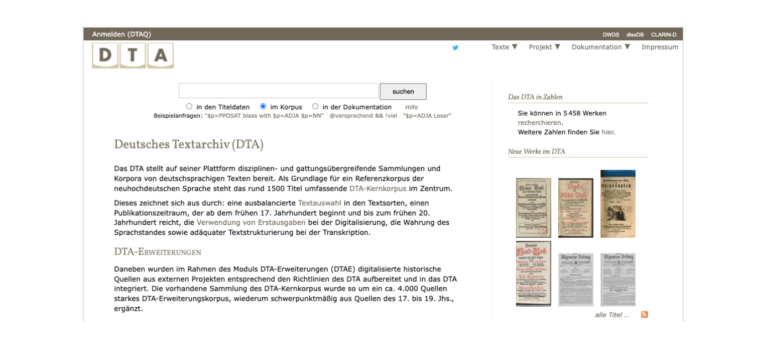
Das DTA ist ein Archiv für deutschsprachige, historische Textsammlungen an der Berlin-Brandenburgischen Akademie der Wissenschaften. Es umfasst annotierte Volltexttranskriptionen von

Nachhaltiges Forschungsdatenmanagement ist zentral für künftige Forschungen! Dies zeigt etwa die Geschichte der Bonner Längsschnittstudie des Alterns. Fast zwanzig Jahre
CLARIAH-DE ist ein Beitrag zur digitalen Forschungsinfrastruktur für die Geisteswissenschaften und benachbarte Disziplinen. Durch die Zusammenführung der Verbünde CLARIN-D und

The DARIAH-DE Geo-Browser enables a comparative visualization of several queries and supports the display of data and their visualization in a correlation of geographical spatial relationships at corresponding points in time and sequences. This allows researchers to analyze space-time relations of data and source collections and at the same time establish correlations between them.

Die im aschkenasischen Europa und Norditalien verbreiteten Pinkasim – Protokollbücher jüdischer Gemeinden – sind zentrale Quellen zur Erforschung der jüdischen Geschichte und Kultur der Frühen Neuzeit. Bisher weit verstreut über Archive und Sammlungen in Israel, Europa und den Vereinigten Staaten, wurden die Gemeindepinkasim im Rahmen des Projekts digitalisiert und in einem Onlinearchiv zugänglich gemacht.
Wir verwenden Cookies und ähnliche Funktionen zur Verarbeitung von Daten. Die Zustimmung ist freiwillig und kann jederzeit widerrufen werden.