CLARIAH-DE ist ein Beitrag zur digitalen Forschungsinfrastruktur für die Geisteswissenschaften und benachbarte Disziplinen. Durch die Zusammenführung der Verbünde CLARIN-D und
Short description of the project
The Hamburg Center for Language Corpora serves to promote the creation and use of digital language corpora in research and teaching. It sees itself as a competence center that builds and consolidates technical, methodological, and organizational expertise for working with language corpora. As a cooperative partner, the current team provides individual researchers and educators at the University of Hamburg with the necessary expertise for research and teaching tasks. In its work, the HZSK collaborates closely with the Hamburg Center for Sustainable Research Data Management.
Project content
The Hamburg Center for Language Corpora is a consortium of members from various departments and institutions of the University of Hamburg. It supports the advancement of computer-assisted empirical research and teaching in linguistics and related disciplines at the University of Hamburg and beyond. The primary goals of the HZSK are:
The Hamburg Center for Language Corpora sees itself as a competence center that builds and consolidates technical, methodological, and organizational expertise for working with language corpora. It acts as a cooperative partner, providing this expertise to individual researchers and educators at the University of Hamburg and beyond for research and teaching tasks. As part of emerging infrastructures that are intended to enable novel forms of access to and work with digital data resources, the HZSK ensures that resources available at and developed by the University of Hamburg can be connected to these infrastructures. In this context, the center aims for long-term cooperation with other centers, contributing services specific to Hamburg's profile and utilizing suitable services from cooperating centers in exchange.
Prof. Dr. Kristin Bührig
kristin.buehrig@uni-hamburg.de
Find out more at
www.slm.uni-hamburg.de/hzsk/
Add your DH research project to the project showcase by submitting a short project description via the web form. Enter project data, a brief description, a graphic or visualization as well as a detailed description of the project content with technical assignment, addressees, added value, project managers, funding information and duration.

CLARIAH-DE ist ein Beitrag zur digitalen Forschungsinfrastruktur für die Geisteswissenschaften und benachbarte Disziplinen. Durch die Zusammenführung der Verbünde CLARIN-D und

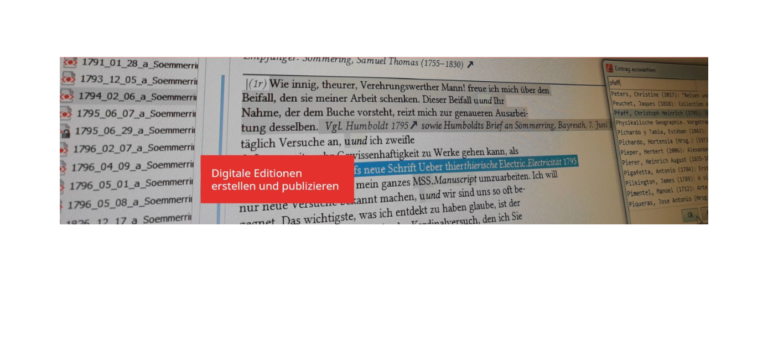
Die digitale Arbeitsumgebung ediarum ist eine aus mehreren Softwarekomponenten bestehende Lösung, die es Wissenschaftler*innen erlaubt, Transkriptionen von Manuskripten und Drucken
Das von der Deutschen Forschungsgemeinschaft geförderte Projekt Diccionario del Español Medieval electrónico (DEMel) hat zum Ziel, der Öffentlichkeit ein lemmatisiertes

Der Vergleich als methodisches und epistemologisches Paradigma ist in den Geisteswissenschaften tief verankert. Ob in der qualitativen oder quantitativen Forschung

Die Website „Der Holocaust in Ungarn und die Deportationen nach Norddeutschland“ präsentiert Ergebnisse aus dem transnationalen Projekt „Digitale Gedenk- und

ZenMEM ist ein dezidiert offener Verbund von Wissenschaftler*innen und darum bemüht, gemeinsam neue, digital gestützte Forschungsmöglichkeiten im Bereich der Kulturwissenschaften

Digital edition of the economic-technological encyclopaedia by J. G. Krünitz, published in 242 volumes from 1773 to 1858.

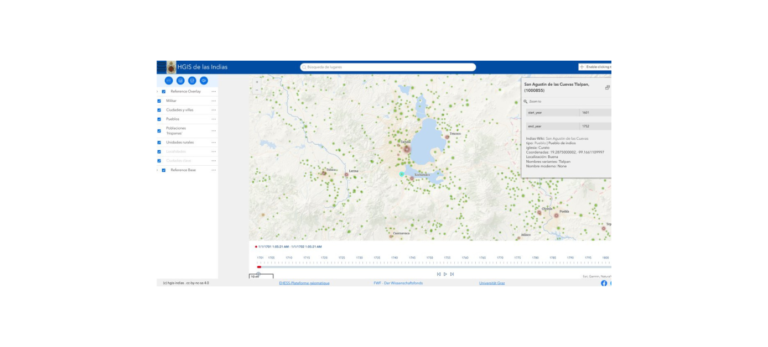
The DARIAH-DE Geo-Browser enables a comparative visualization of several queries and supports the display of data and their visualization in a correlation of geographical spatial relationships at corresponding points in time and sequences. This allows researchers to analyze space-time relations of data and source collections and at the same time establish correlations between them.
Wir verwenden Cookies und ähnliche Funktionen zur Verarbeitung von Daten. Die Zustimmung ist freiwillig und kann jederzeit widerrufen werden.