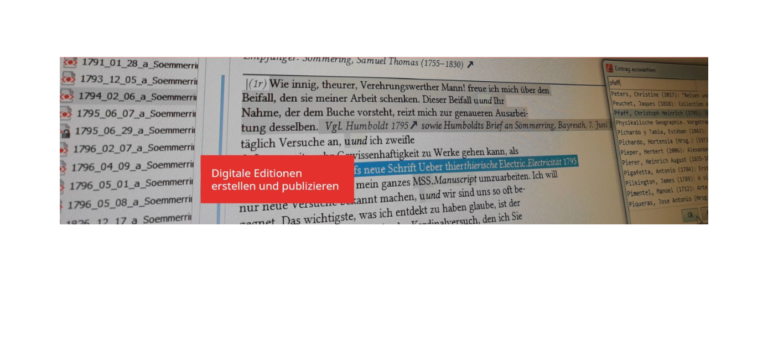
Der Webservice correspSearch wurde entwickelt um ein lange bestehendes Desiderat von Briefeditionen zu beheben: Die edierten Briefe editionsübergreifend durchsuchen zu
Short description of the project
The Diccionario del Español Medieval electrónico (DEMel) is a semantically pre-structured and lemmatized database dedicated to the Medieval Spanish. The basis is the digitized archive of the Diccionario del Español Medieval (DEM), which was discontinued at the end of 2007 for financial reasons. With more than 600 literary and non-literary works or collections of texts and documents as sources, the material represents the Spanish vocabulary from the 10th to the beginning of the 15th century.
Project content
The project Diccionario del Español Medieval electrónico (DEMel), funded by the German Research Foundation, aims to create a lemmatized and semantically pre-structured electronic data archive on medieval Spanish that is freely available and searchable on the Internet. Based on the digitized archive of the renowned Diccionario del Español Medieval (DEM), it provides access to over 31,000 lemmas with about 650,000 attestations from the 10th to the beginning of the 15th century.
In the course of digitization and indexing, approximately 865,000 paper slips - including around 700,000 slips on which the medieval word forms are written with their respective context of use, the source and their dating as well as, for example, grammatical, semantic and etymological information - were first scanned. Afterward, the project team developed a database structure and recorded the information contained on the paper slips manually.
The DEMel web portal developed at the University of Rostock now offers users the opportunity to evaluate the material in a structured manner according to their individual research questions using several search and filter functions. The great diversity of topics and text types covered by the underlying corpus (fiction, religious and legal documents, technical and scientific treatises on astronomy, mineralogy, botany, etc.) makes it possible to examine previously unrecorded aspects of medieval Spanish vocabulary. This makes the web portal a valuable source of information for Hispanists as well as for scholars from other disciplines (e.g. Arabic and Jewish studies, theology and Latin studies).
dem.electronico@uni-rostock.de
Find out more at
https://demel.uni-rostock.de/
Add your DH research project to the project showcase by submitting a short project description via the web form. Enter project data, a brief description, a graphic or visualization as well as a detailed description of the project content with technical assignment, addressees, added value, project managers, funding information and duration.

Der Webservice correspSearch wurde entwickelt um ein lange bestehendes Desiderat von Briefeditionen zu beheben: Die edierten Briefe editionsübergreifend durchsuchen zu

Das Hidden Kosmos – Reconstructing Alexander von Humboldt’s »Kosmos-Lectures« widmete sich von 2014–16 der Ermittlung und Verzeichnung, Bild- und Volltext-Digitalisierung

Arthur Schnitzler gehört zu den bedeutendsten österreichischen Autoren und war ein produktiver und gut vernetzter Briefschreiber. Seine Korrespondenz wurde jedoch

Das Ziel der Bibliotheca legum ist es, einen Überblick über die handschriftliche Produktion weltlichen Rechts in der Karolingerzeit zu geben.

Das vom Bundesministerium für Bildung und Forschung (BMBF) geförderte und am UCLAB der FH Potsdam angesiedelte Projekt Restaging Fashion (11.2020

ELAN wird am Max-Planck-Institut für Psycholinguistik im Sprach-Archiv (TLA – The Language Archive) entwickelt. Es wird in der Programmiersprache Java

Dietrich online provides bibliographical information on approximately 5 million journal articles and newspaper articles published in the German-speaking world between 1897 and 1944 in an online database searchable by author name, title keywords, German-language keywords, journal or newspaper titles and year of publication.

The Bibliotheca legum aims at providing an overview of the textual production of secular law texts in the Frankish empire. Descriptions (according to TEI P5) of all manuscripts containing secular legal texts (leges) as well as other contextualising material are presented.
Wir verwenden Cookies und ähnliche Funktionen zur Verarbeitung von Daten. Die Zustimmung ist freiwillig und kann jederzeit widerrufen werden.